Showing posts with label labor. Show all posts

Tuesday, January 5, 2016

Too Weak?

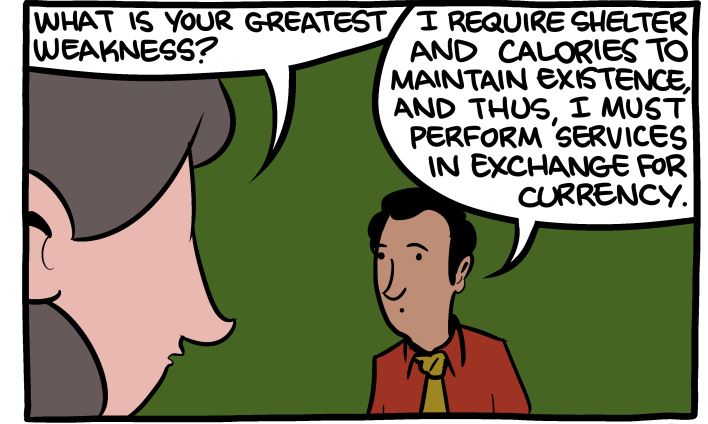
There is a problem with human workers.  Here it is:


Does this mean that ALL exchange is not euvoluntary?  Is it true that we "must" perform services in exchange for currency? I have heard people argue just this point.  Since we need food, all payment for labor is exploitative.  Of course, usually there are many different ways for me to earn money.  But suppose there is only one?  The "company town" thing.

Here is the entire SMBC comic, which is wonderful...  Perhaps the problem is honesty?

Tuesday, June 9, 2015

I Will Show You Despair in a Handful of Smiley Face Buttons

Wal-Mart hiked wages effective in April, with more to come by next year. Already they're reporting two important features of the new policy: lower turnover and an increase in the volume of applications. Since training new employees is expensive and time consuming, it sounds like this could be to the firm's advantage. It's difficult to say for sure without actually seeing the accounting documents, of course. And differential training cost estimates are not mandatory 10-k filings, so it's likely I'll never be able to really say for sure.

But what I can say for sure is that if the Reuters report is accurate, there have been quite a few disappointed applicants since April. For the folks who find a job and keep it, the wage increases are wonderful. But for the folks who never even get called back, well, they are obliged to look elsewhere. The benefit to incumbents comes at the expense of aspirants.

And that's fine. That's Wal-Mart's concern. They are in the business of selling consumer products to customers. They are not a works project, they are not a charity. Any in-house hiring or wage rate decisions they make are reflected in their marketplace performance. I certainly don't know how to run Wal-Mart any better than the residual claimants of the firm or their agents. And anyone who claims otherwise should probably be viewed with a great deal of skepticism. What I do know is that we should also be skeptical of claims that the entire labor market can follow this example and expect to flourish. If someone isn't worth hiring at Wal-Mart at nine bucks an hour, it's likely they're not worth hiring at Tom's Tobacco Hut at nine bucks an hour. He needs to have a way to bid down his asking wage, and with minimum wage statutes in place, that's malum prohibitium illegal.

Work is not euvoluntary for the least productive members of society. It's worth remembering that when we petition the state to price them out of work entirely.

Tuesday, October 7, 2014

Rorschach's Journal. Oct 7, 2014

"The streets are extended gutters and the gutters are full of blood and when the drains scab over, the vermin will drown."

Angus is right. Labor economics is hard, but it ain't that hard. It is possible to have a G.E. with economy-wide efficiency wages, even with mobile capital. What may not be possible is for workers to insist on efficiency wages. The heyday of the workers' union is over, at least apart from SEIU. My own dalliance with a union job was with the Needleworker's Union, in my capacity making shirt buttons in Connecticut. US Button stays open because of military procurement legislation and for no other reason. When I worked there, the chief competitors were all Korean. The factories overseas were highly automated. As a press operator, I could crank out a 55-gallon drum's worth of raw buttons in a shift, but one Korean worker (who was really more like an assembly line supervisor) could be the only human in charge of producing ten times that many finished buttons in the same amount of time. Automation is insanely productive. Watch the Canadian TV show "How It's Made" sometime to see what I mean.

And if Munger is right about the fundamental purpose of the firm dissolving before our very eyes, then the future of (many kinds of) production will further erode workers' ability to unionize. One unflattering way to think about the sharing economy is to call it scab-enabling technology. P2P matching software automates middle management, directly connecting line workers with customers. Without a management structure to negotiate with, both efficiency wages and union bargaining vanish. When everyone is a scab, no one is a scab.

Is a be-your-own-boss world more euvoluntary  or less than one in which organizational costs are high? Wages will fall, sure. But so will the cost of services, since consumers won't be obliged to pay premiums to support back-office operations. Productivity should increase, and a more productive society is a more prosperous society.

And more curiously, how consistent is the support for one way over the other? Taxi drivers are a sympathetic constituency for the typical working stiff, so Uber threatens class solidarity. But auto-arbitrage in the blockchain also eliminates the need for currency arbitrageurs, so employment in the finance industry will take a hit. Is it cool to get rid of Louie DePalma if it also means we can kick Gordon Gekko out on his keister?

At any rate, will it or no, it's likely to happen. Ned Ludd has long stood athwart history, chucking clogs into the machine, but all that comes out the other end is smoke and splinters. The prudent course is to learn to love the machine.

Rorschach dies at the end.

"The accumulated filth of all their sex and murder will foam up about their waists and all the whores and politicians will look up and shout 'SAVE US!'...and I'll look down and whisper 'No.'"

Tuesday, May 13, 2014

Goosey Goosey Gander

Þe olde headline meme.

Company Rescinds Ohio Man's Job Offer after Learning He Was Home Schooled

Guy gets a "diploma" from mom and dad, takes a few college courses along the way. A publicly traded (NYSE: NI) energy company gives him a job offer, then yanks it after they find out he doesn't have state-provided education credentials (not even a GED). All hell breaks loose on the blogs.

It would be tedious to rehash why labor is voluntary but not euvoluntary. Instead, ask yourself if similar moral intuitions would apply if the situation were reversed. Suppose the employer was a consortium of homeschooled ladies and gentlemen, and they rescinded a job offer when they found out an applicant had attended public school. Would that strike you as unfair?

Do minorities retain the moral latitude to discriminate against the majority? If your answer leans "yes", then does it have anything to do with BATNA disparity? Is it only the underprivileged that have a free pass to discriminate, or is any minority at liberty to move about the cabin? Should homeschooled students constitute a protected class?

Should any group constitute a protected class?

Thursday, April 10, 2014

Little Pink Houses

Wal-Mart's FY 2013 SEC 10-K filing.

Excerpts

Total Properties:                                                             11091
Total shares repurchased [avg price per share, USD]:     42,288,364 [69.60]

Total Revenue (millions of USD):                                    476,294
Cost of Sales:                                                                 358,069
Net Income:                                                                     16,695
Comprehensive Income:                                                   13,613

Total Assets:                                                                  204,751
Current Liabilities:                                                            69,345
Total Equity:                                                                    81,339

Accrued Wages and Benefits:                                            4,652
Retirement Liabilities:                                                         1,062

and from the Wal-Mart homepage,
Number of Employees:                                               2,200,000

Accounting works differently than economics. In economics, we're quick to point out that interventions have consequences. Third party interference with bilateral contracts may produce unintended consequences. Let's ignore that for a moment and simply straight-up assert that if Congress decides that Wal-Mart must pay workers more, there will be no disemployment effects, no rent capture, no substitution, not even a perceptible shift in the labor supply curve. Instead, we'll just shift cash flows from one bin into another.

But which bin?

Living wage proponents seem to assume that it'll come straight from the "Net Income" bin. R. Reich for example likes to talk about stock buybacks and $16B (for 2012), suggesting that he doesn't consider Consolidated Income to be particularly important.
Your typical employee is now earning $8.25 to $8.80 an hour. Most are adults, responsible for bringing in half their family's income. You can easily afford to pay them $15 an hour without causing layoffs or requiring price hikes. Your shareholders and executives are doing spectacularly well.
I'm not sure what he means by "typical" employee in this passage, so let's go with "median". Let's also restrict it so that the median is de minimis, that of the 2,200,000 employees working for WMT, 1,100,001 of them make at the top of the his low-wage band, the $8.80/hr. Let's also assume that the "typical" employee cares more about take-home pay than about a nominal hourly wage, so this employee both now works, and will continue to work, a standard 40-hour workweek, with 2 weeks off per year for vacation.

A little grade-school arithmetic shows (15-8.8)*(1,100,001)*(40)*(50) = 13,640,012,400

Ignoring incentive effects, Reich's proposed raise would have a minimum price tag of $13.6B. It would eat every penny of the most recent SEC 10-K filing Comprehensive Income. And even if you think Net Income is the proper line item (it isn't), it would mean cutting dividends. As a reminder, the lion's share of blue chip dividends go to big time institutional investors like pension funds, so it's not so much robbing plutocrats as it is transferring wealth from prudent retirees to current workers. If that's your idea of sensible redistribution, I'm not sure I can talk you out of it. But do please consider what that implies for your own retirement.

But yanking cash flows from the CI line is but one possible bin. Even dullard versions of capital pricing models insist that costs will be spread around. Will some of the cost come straight out of the bottom line? Sure, but some of it will also come out of the retirement liabilities, some of it from Total Assets (which includes, among other things, property/plant/equipment aka new stores, trucks, and the operating capital that makes employees productive in the first place). Winching down on this line item means giving up de novo employment opportunities for the many involuntarily unemployed people currently drawing UI across the nation. Again, if your model is that it's better to have no job at all than to have a low-paying job, that's another matter, but you might consider explaining your reasoning to the people who actively seek jobs at Wal-Mart at the prevailing rate.

Another possible bin to pilfer is Gross Revenue. Maybe customers could eat the increased labor costs. Of course, prices are information, and there's no reason whatsoever to ditch the first law of demand in consumer goods, particularly the sorts of goods sold at WMT. Holding all else constant, price is inversely proportional to quantity demanded. Consumers are likely to respond to higher prices with ordinary abstention.

There ain't no such thing as a free lunch. And while it's great to acknowledge that there are no solutions, but only tradeoffs, I implore anyone who reads this to please carefully consider whether or not you're being realistic when you imagine what the actual tradeoffs might be and whether you're willing to foist them on others without so much as a jot or tittle of accountability on your part.

Labor is not euvoluntary, especially for marginal workers. Temper your enthusiasm for intervention accordingly.

Friday, December 6, 2013

Shoes, Ships, Sealing Wax, Cabbages, Kings

Why is the sea boiling hot? Rancor. Rancor over the working poor. Rancor over minimum wage legislation, and rancor over transfer programs. How does this happen? Well, let's ask the Rancor.

Zac G.: The working poor are back in the news as fast food employees gear up to strike for a higher minimum wage. As we know from both theoretical and empirical economics, mandated minimum wages tend to have disemployment effects for marginal workers, particularly the young, the less-well educated, and minorities. The arguments in support of a higher minimum wage are well-intentioned, but ultimately misguided. There are better ways to help low-income households, like wage subsidies or a basic income.


Kevin Drum scoffs at the wage subsidies idea for practical political reasons here. According to him, "a higher minimum wage is the only game in town." He also reads the empirical literature as claiming that the effects of MW legislation on employment as being close to zero. But there's more. 

Noah Smith: A job is more than just a paycheck. It's dignity, it's accomplishment, it's GDP+. If all you economists would stop being so parochial for a minute and go check out some of the other literature out there, you'll find that being able to provide for your family is causally connected to things like life satisfaction, health, longevity, &al. Working for peanuts is demeaning for individuals and has disruptive consequences in the aggregate. Duh.


But there's still more. 

Steve Landsburg here and here: The productive value of labor is an entirely separate consideration from poverty relief. If you want working families to have more disposable income, that is if you think poverty relief is a public good, then the just, fair policy is to fund transfer programs from the general coffers, not to force firms to take on possibly ruinous payroll obligations.


Garett Jones: More to the point, firms substitute capital for labor. I propose we call minimum wage legislation a "full employment for robots act." ATMs, self-checkout lanes, specialized farm equipment, the lack of movie theater ushers, and pump-your-own gas can all be explained pretty well by labor market interventions. Instead of hiring teenagers, business owners will relieve themselves of the expensive hassle by swapping in a machine. I for one welcome our future robot overlords.


You might reply by saying that the jobs replaced by robots are bad jobs anyway and like the farrier and the coachman, should probably be relegated to an historical dustbin, but I urge you to consider what the alternatives are. Yes, it might be that we can just send every boy and every girl off to college to springboard into a high-skilled career, but that doesn't square with a casual observation of the actual people you probably actually know.

Bryan Caplan: meep meep meeeep meep

Translation: It's worse than that. Since we're talking about service industry jobs, substitution in the form of DIY is a substantial threat to the stability of entry-level positions. Sure, an employer could replace a cashier with a touch-screen display, but even in the short term, a customer can replace a Big Mac and fries with a bag lunch from home. 


Don B. offers a thought experiment here to get at the practical morality behind MW increases. My impression is that someone could look at all the economic arguments against the MW and reply: "dogmatic free-market economists don't care about poor people." And when they do, oh boy, watch out. Here's one of our favorite apostates, linked here at EE yesterday.

Matt Z: Hey guys, how about a Basic Minimum Income? Novice workers can still get work and develop elementary workplace skills, and not have to worry about being caught in vicious poverty traps. Sure, there are probably some political barriers we have to overcome, but come on you guys: Milton Friedman ended military conscription in the United States. If he can fight the Pentagon and win, we've at least got a shot at reforming the welfare state. Right? Guys?


Munger: I like this guy. Makes sense. I won't bet on it happening anytime soon though. 


But the real hell broke loose in the comments. How dare Zwolinski retain the audacity to label himself "libertarian" when he so bald-facedly proposes to pick the pockets of his neighbors to ply his pet project of redistribution? 

I'm being kind with that paraphrasing. I won't link to the actual responses, but I will say that I've got a lot more sympathy for my neoliberal dudebros who claim that libertarians are borderline psychopathic after seeing yesterday's fallout. Egads. 

Anyway, Russ Roberts recently sponsored an essay contest comparing and contrasting T. Cowen's (crypto-pessimistic) and J. Mokyr's (historo-optimistic) visions of the future, and whichever view you align with, you'll probably agree that this debate is likely to become increasingly salient as the Jones Effect (pro-robot, ie probot) settles in. 

TGP: Hey Wilson! Aren't you forgetting something?
FiSH: Go easy on the kid. Maybe he fell on his head.
TGP: But this is the Euvoluntary Exchange blog, Steve. Shouldn't he be discussing, I don't know, euvoluntary exchange?
FiSH: That'd be great. There's a first time for everything.
Both: ho ho ho ho ho

Thanks guys. The trouble with making a coherent story about low-skilled labor is that there's always going to be disagreement over the counterfactual state of the world. All the thought experiments you can dream up, all the empirical studies you can cite, all the pathos you can muster will fall on deaf ears if your audience refuses to accept your description of the alternatives. I can say that the minimum wage will swap out workers for androids, but you can say that other opportunities will come along in a dynamic economy. I can say that over a long enough time horizon, all policy is subject to change, but you can say we can't wait that long. I can say that non-euvoluntary labor agreements are worse under coercive political circumstances than under laissez-faire, but you're under no obligation to believe me.

What makes my counterfactuals more plausible than yours? How am I more correct about BATNA assumptions than you? This isn't a relatively simple matter the way Norwegian butter import restrictions or airplane seat purchases might be. This is a debate that touches 70% of GDP, spans generations, and has implications far into the future. Because the stakes are so high, it's probably reasonable to expect some truculence.

Anyway, I'll leave JR to give today's closing comments.

You people are insane.

Wednesday, November 6, 2013

Sliding Minimum Wages and Immigrant Labor

Australia enjoys some fame among labor economists who note its relative success with heterogenetic minimum wages. The specific figures aren't that important, but the idea is that young people have lower minimum wages than established adults. The economic intuition is easy enough to understand: it's difficult for new workers to get an entry-level job since they have no experience. A policy that makes it cheaper for employers to take on greenhorns means that these new workers get the important opportunity to build critical work skills without forcing firms to risk forking out hefty wages for someone who could turn out to be dead weight. Win-win, and the median voter can relax a bit knowing that since the lower minimum wage only applies to teenagers, working families won't have to risk ending up on the dole to cover their weekly bread (here is not the place to evaluate the empirical validity of this claim, merely to assert that this belief is common enough in the mind of the median voter to show up as near-universal policy).

How about for newly-arrived immigrants? Would voters be as willing to relax the minimum wage for people who don't necessarily speak English all that well, or would they be inclined to commit the zero-sum fallacy of labor allocation, assuming that jobs created by lowering the wage rate necessarily take work opportunities away from native-born Americans?

Is a flexible minimum wage for immigrants euvoluntary, in other words? If it is, is it politically feasible? Why or why not?

Monday, November 4, 2013

Monopsony Jones

Is the existence of monopsony (single buyer, contrasted with single seller in monopoly) a dashing little bit of a priori theory or a revealed empirical fact? Or is it both? The most uncharitable interpretation of research that finds evidence to support employer shenanigans against their workers is that it's a snipe hunt: researchers with an axe to grind pour themselves diligently into a task that lends some space to exaggeration. I don't think that's the case though. It's my impression that much of the behavioral econ literature is correct in identifying values that underpin wage rigidities, and that even though a lot of the empirical work I've read leans a bit towards question-begging, it's perfectly plausible to me that low-skilled labor is systemically underpriced. In a Bayesian sense, I'd have to say that I have relatively strong priors that the question is difficult to resolve using mere econometrics.

I'd also admit to some waffling over whether or not poverty is a public bad. It's obvious that poverty is bad—it contributes to misery not limited to malnutrition, lower life expectancy, violence (maybe), and a host of petty insults linked to relative status and self-image. But just because something is bad and it happens to members of the public doesn't make it a public bad. To elevate the private discomforts of relative immiseration to a public concern, the advocate either draws on the sense of pity that slumbers in all feeling peoples or appeals to spillover effects, as one might with public health initiatives (scarlet fever might be spread thanks to collective action lacunas, eg). Recall that excludability is a necessary condition for public goods or bads. Let's assume that both the normative (pity) and the positive (spillover) case has been made and that yes, having poor people around makes everyone worse off.

I'll leave it as an exercise to the reader to decide who in this exercise has moral weight, if people born on the wrong side of a political border should influence either our tender spirits or whether the malaise of poverty slips the border patrol in the dark of night.

So if we accept premises (a) that a firm can be a monopsony buyer of labor and (b) relative poverty is a social rather than a private condition, by what logic might we arrive at the bramble of bureaucracy that penetrates poverty relief efforts that hover from local all the way to international? Imagine all the talent that could be freed by salting the earth where the thicket of wage intervention and in-kind transfers once stood in lieu of a universal guaranteed minimum income. Think about disconnecting poverty relief from work.

That's the bulk of my pitch for a basic income. I think it's probably not that much of a stretch to say that it would be more euvoluntary than the status quo. But what it's missing, why no one has seriously forwarded a proposal that would shutter big swaths of the federal budget falls afoul of the illusion of Tantalus. What looks like low-hanging fruit might actually be the jawbone of an ass wrapped in a palm leaf.

Paternalism is popular. And by "popular", I mean that even loopy libertarians harbor pretty strong preferences over what constitutes right behavior (they're just less inclined to wield the cudgel of the state to see their ideal world flourish). Disbanding state-run poverty relief programs disrupts the thousand little fingers folks use to prod others, be it in matters of recreation, mastication, or procreation. To my consternation, I have to admit that there's massive (misguided if you ask me) social benefit to lending state force to scolds, left and right (which side is in ascendance is probably more a matter of luck than anything), so efforts to muzzle leviathan will be met with thrashings of the beast itself over the frenzy of its handlers.

Then again, maybe I'm wrong about the relationship of work, income, paternalism, and poverty relief. What if the underlying purpose of minimum wage statutes isn't to make sure that workers break the spine of employer monopsony but to erect a palisade to segregate undesirables? What if Hume was right and the true purpose of leviathan is to encrease its dominions? Is it not futile to stand athwart both history and society, shouting "here and no further" as the beachhead of petite bourgeois dignity is worn underfoot? Is the universe of euvoluntary exchange better expanded by entrepreneurial endeavor or by resistance to the scope of state coercion? I'm not asking as a rhetorical device. I legitimately don't know the answer.

And to try to plumb it more, I'll do another post on Kirznerian entrepreneurship by the end of the week. Stay tuned.

Monday, September 30, 2013

Sometimes They Capitalize... Again

Labor market regulations are curious beasts. via Ed Lopez, French hardware firm Leroy Merlin has plopped itself in the middle of an elites-vs-commoners hue & cry over Gallic Blue Law.

Sometimes, labor market interventions are transformed into capital structure changes. Cesar Chavez saw to it with the might of the UFW behind him that field worker wages were pinned higher than the market would bear. Unsurprisingly, farmers stopped hiring as much migrant labor and turned to machines to do many of those low marginal product jobs. The intervention was capitalized.

Probably not so with Sunday prohibitions. These aren't, as the game theorist might say, evolutionarily stable. Nor is there a coordination failure that I can see. Individual firms probably wouldn't lose permanent business if they were to shutter their doors once a week.

Labor is not euvoluntary, but the Sunday exception seems odd even in a Catholic country. It ought to be up to the individual conscience of the worker if they're willing to set aside a day for rest.

I think. I might be wrong. I may have missed the part in the Bible where it said something about the king keeping the Sabbath day holy.

Saturday, September 28, 2013

Toward a Euvoluntary Military Service

From Anthony Gregory, writing in Reason:
Rather than reinstating the draft, a less drastic proposal exists, one more consistent with human rights, more conducive to peace, and more respectful of those on the front lines: a truly voluntary military. Today, unlike most any other U.S. institution, the armed forces practice indentured servitude: Employees agree to a term of service and face imprisonment or even execution should they quit. We do not consider it a "voluntary" job if a warehouse or factory forcibly prevents workers from quitting at will. Those who wish to honor the humanity of America’s soldiers should agitate not for conscription but for the freedom to resign. The remaining soldiers would be there by choice, and if they continued fighting unjust, counterproductive wars, it would be harder to regard them as victims of bad leadership and an apathetic populace.
ATSRTWT

 This is actually part of Chapter 3 of my dissertation, so I could discuss it at length. I'm cruel, but I'm not that cruel. Instead, I want you to ask yourself if the nature of a fixed labor contract for military service is necessarily coercive on net. Be sure to show your work. Remember that in order to establish systematic bias, you need to have some evidence of fraud or of an admixture of excess kurtosis coupled with excessively high discounting.

It's easy enough to model a coercive military service using an extensive form game, but it might be less easy to provide empirical evidence to support that theory. How would you build your case?

Sunday, September 8, 2013

Labor is not Euvoluntary: LFP Edition

Kevin E. at Idiosyncratic Whisk picks up on an ongoing row folks are having over labor force participation. Tyler linked to a WaPo article that makes some curious claims about the causes of LFP malaise. He says (in the comments): "I am (mostly) not blaming cycle, rather seeing the trend, most of your points do not overturn my view." That was my reading too. The up-edging of elderly workers still in the labor force provokes consideration of what Richard Epstein was talking about in this video (please ignore the socks and unicorn flatus to the best of your ability):


Epstein's point, the one that Skidelsky adamantly rejects, is that it is labor market barriers that is keeping folks out of work. Things like uncertainty over off-balance sheet liabilities, minimum wage requirements, threats of forthcoming legislation, even mandatory health coverage provision (and I don't want to dwell too closely on that one, given some of the shady comments I've read lately) all contribute to an edifice of business uncertainty. Add to that the rank regime uncertainty we've seen since the start of the Bush II administration, and it should be no great surprise that employment is wobbly.

A brief technical digression:

For the uninitiated, LFP is another metric for analyzing employment. If you're so inclined, you can check out reports, data, statistics, whatever so you fancy at the BLS page for employment here. The typical "unemployment" figure that gets reported in the press is U-3. Here's a list of the different measures used by BLS:

U-1 Persons unemployed 15 weeks or longer, as a percent of the civilian labor force
U-2 Job losers and persons who completed temporary jobs, as a percent of the civilian labor force
U-3 Total unemployed, as a percent of the civilian labor force (official unemployment rate)
U-4 Total unemployed plus discouraged workers, as a percent of the civilian labor force plus discouraged workers
U-5 Total unemployed, plus discouraged workers, plus all other persons marginally attached to the labor force, as a percent of the civilian labor force plus all persons marginally attached to the labor force
U-6 Total unemployed, plus all persons marginally attached to the labor force, plus total employed part time for economic reasons, as a percent of the civilian labor force plus all persons marginally attached to the labor force

Clear as mud, huh? Well, a "discouraged worker" is someone who can't find a job and who has more or less given up. The stereotype is the 20-some-odd college grad who has moved back in with her parents and spends her days instagramming on Pinterest or whatever it is the kids are doing these days.

But as Erdmann notes, we're actually seeing two things going on. Yes, we have some noise, but there are longer, larger trends at play. And if you'll note in the WaPo piece, the pie is increasingly sliced onto grandpa's plate. The 75-79 y.o. LFP rates are up. Considerably.

What do I make of this? Well, maybe 2008 exposed some of the malaise Washington DC and the several states have been legislating into the labor markets over the course of the past few administrations. We've been seeing at least a little more executive discretion when it comes to enforcing the rule of law. We've also seen generally more pugnacious law enforcement, and we're seeing new graduates caught in a peacock-plume dilemma, so perhaps it's understandable that employers are slightly more reluctant to hire on Johnny BA with no experience in lieu of Gregory Grandpappy who may be a little long in the tooth and grey in the eye, but who still knows how to work the system and crank out the goods.

It's a hypothesis anyway. A few charts here and there won't resolve the issue. But the disaggregated LFP rates seem to at least point to the suggestion that Epstein and Roberts aren't blowing hot air across the stage (and I see no horns atop their foreheads in any case) when they talk of structural uncertainty.

Which then makes me wonder: what's worse, legislatively "correcting" what may be phantom errors in the labor market, or using tools that end up ensuring very few young people get their foot in the door? Is it more euvoluntary to have a 25% chance of landing a legislatively protected job or a 90% chance of landing a caveat operarius gig with relatively free entry and exit? How much of that question hinges on positive analysis, how much on normative judgement? Is it right to force workers to pick only one option?

As for the DI argument, I'm not convinced it's an especially important margin. If there is malingering, then it's probably low productivity workers doing it anyway, so it's no great loss, all things considered.

Monday, September 2, 2013

Bargaining Power and Immigration: The He-Man Conjecture

The masses have spoken. You seem to like my little dialogues, so here's one between Eric the Economist and Pete the Pedestrian.

Eric: Hey guys, what if wage and income justice are two separate concerns? Economics tells us that in competitive markets, W=MPL. Social justice tells us that mothers who can't buy baby formula is intolerable. Why not get out of the way of wage pricing so that competition can do its job of striving towards full employment and provide a guaranteed minimum income so that no one has to eat garbage or whatever it is very poor people do to keep from dying.

Pete: Typical economist drivel. Jobs aren't about wages, they're also about dignity. A paycheck earned is more than the bundle of rights it commands in your vapid formulations. It's dignity. It's pride. Your handouts insult folks' self-esteem.

Eric: Well, we've got this idea in economics called "revealed preference" that suggests that workers who actually do value the self-esteem generated by productive work will seek to become more productive workers. They accumulate skills, education, discipline, they lay their hands on those characteristics that serve both their narrow self-interest and the interests of their customers and employers.

Pete: What a load of bull. Pay and productivity have nothing to do with each other. Can you link CEO pay to actual value generation? No. And in case you haven't heard of a little something called "bargaining power", there's another idea that says that employers can bid down wages like crazy since low-skilled employees are a dime a dozen.

Spivonomist: Hm. Interesting, Pete. That's actually an empirical claim. Yes, there's the normative notion of BATNA disparity in there that underpins your moral intuition, but is it actually the case that employers enjoy a superior bargaining position? Let's see what the literature has to say.

And the econ literature is a little inconsistent. Where it is pretty clear is when it comes to immigration. Study after study after study (including my own research) shows that middle on up immigration is a complement for native labor. That is to say that professionals that come to work in the US appear to actually boost the wages of natives. Only for low-skilled labor does this pattern reverse, and the effects tend to be pretty mild. Statistically significant, yes, but the magnitudes are small (in my judgement anyway) and they don't linger.

This seems to suggest to me that the bargaining power is actually on the side of the low-skill native workers' side. Only by restricting the supply of their competition can they sustain artificially high wages, just like plain-jane relative price economics predicts. Low-skilled labor is not euvoluntary, but for the precise opposite reasons that are usually brought to bear.

Of course, there's a lot more to it than that. The question is fraught with measurement bias, longitudinal concerns, endogeneity problems, and GE projection errors. What if most of the problem can be attributed to the capitalization of existing labor market restrictions? Important concerns, of course, but I think it might be wise to reconsider how we think about the relative market power of different productive entities.

Tuesday, July 16, 2013

Labor is not Euvoluntary: Golden Arches Edition

Buzzfeed reports on trouble in McDonaldland. Ray Kroc's company acknowledges that its line employees can't make ends meet on a minimum wage.

The BATNA for low-skilled work is always and everywhere ugly. This is an economic reality, one that can't be ignored by any amount legislative fiat. Low-skilled workers simply aren't that productive. That's what it means to be low-skilled.

The solution is to allow them to gain valuable skills. By letting them participate in the world of work. The solution is emphatically not to price them out of the market by making it prohibitively expensive to hire them and forcing firms to turn entry-level jobs over to automation.

It's true that entry-level work is not euvoluntary. All the more reason to avoid legislative meddling.

Monday, May 20, 2013

Poppin' Tags

HuffPo reports that Goodwill Industries employs people with disabilities at wages below the government mandated rate.

ATSRTWT

Note the rhetorical strategy: highlight the CEO pay as if it's somehow relevant for the MRP of the line employees. BATNA disparity up one side and down the other. Outrage.

Question for the Euvoluntary Exchangers in the house: is it ever possible to have a euvoluntary labor contract with someone who has severe cognitive disabilities? Milton Friedman was famous for carving out agency exceptions for the disabled. If there is some limit to the ability of some folks to commit to contracts, how are those limits prescribed? "You're taking advantage of these poor folks" isn't much of an argument from afar. There are too many plausible counterfactual stories to tell without closer case-by-case inspection, no matter how offensive it seems.

But I have to agree that in the absence of closer inspection, it does sure taste offensive. I'll be interested to see how Goodwill responds.

Wednesday, May 1, 2013

Euvoluntary Labor and Workplace Safety in Bangladesh: Wilson on Bill on Yglesias

At Groping To Bethlehem, "Bill" questions Matt Y.'s comprehension of institutional economic analysis in response to the tragic Bangladeshi version of the Triangle Shirtwaist Factory Fire that happened in New York in 1911 . Note the points he makes towards the bottom of the post. In a nutshell, the problems of Bangladesh are: industrial monopsony (BATNA), information asymmetry (regret condition), and institutional corruption (coercion by human agency). These three bullet points could have been lifted straight from the EE playbook.

Labor in Bangladesh is not euvoluntary.

Good, it's critical to identify this feature of the Bangladeshi economy, because it helps inform what a reasonable, ethical response might look like. A reasonable, ethical response includes unilaterally lowering any trade barriers that might remain with the impoverished country, and granting unlimited work visas in lieu of open borders (policies that the median voter should support anyway based on the likely outcomes).

Okay, maybe my libertopian flights of fancy, even if there's something close to unanimity in the economics profession supporting free trade (in goods if not necessarily always in migration), might be a bridge and half too far. At the very least, it's important for the sake of Bangladeshi workers that well-intentioned outsiders don't push for disruptions to what is famously one of the most fragile economies in the world.

Look, language is a funny ol' boy. We have at least three terms for the pretty much the same thing: "industrial policy" (meaning protectionist policies), "boycott", and "embargo". The practical result among this trio is the same: inhabitants of the target country (as well as the aggressor country) are made poorer by reduced opportunities to truck, barter, and exchange. The only difference is in the rhetoric and the mood affiliation.

So cries for boycotts aren't really any different than cries for the same kinds of policies the US has been inflicting on the immiserated citizens of Cuba for over half a century and on the oppressed population of Iraq between the close of Gulf War I and the start of Gulf War II, Electric Boogaloo. Treating Bangladeshis like war criminals hardly seems like an appropriate response to an industrial accident. It's probably wiser to recognize that workplace safety is a normal, perhaps superior good: as income rises, so goeth demand. It's probably wiser to do what we can to build wealth and productive capacity (read: trade with the Bangladeshi people) with them rather than throttle the extent of their market.

On a more positive note, I'm encouraged to see that the Bangladeshi people themselves are demonstrating against poor workplace safety standards: it's (weak) evidence that overall conditions could be improving. Truly desperate people don't have the luxury of marching in picket lines. Accidents notwithstanding, things might be looking up a bit.

Tuesday, April 23, 2013

Unemployment is not Euvoluntary

Thy Dungeonmaster takes free-market economists to the woodshed for a callous attitude towards the chronically unemployed. Do read the whole thing. It's excellent and difficult to excerpt. His point is similar to the one we push here at EE: if consequences aren't part of your moral calculus, you're leaving a big part out of the equation. Similarly, if your analysis of consequences is free of careful, correct analysis, your moral calculus produces the wrong results.

An empirical question, then. What is the form of the game played by the median voter, political elites, idea mongers, and the chronically unemployed? Is it a mere coordination game, where some admixture of folk beliefs about the effects of policy intersect with loss aversion and regret aversion by proxy to produce an array of policies, or is there something else going on, with asymmetries in the payoffs? How important is the bureaucratic apparatus in determining the scope and scale of the regulatory authority? Is there some sort of bureaucratic entrepreneurship effect at work, where folks in regulatory authorities bend their talent to identifying and creating political rent opportunities? How strong are the pressures to construct mercantile institutions whose misfortune is felt by the discarded margins?

Economics is often derided as pitiless, cold, desolate. It substitutes pessimism for the hopes of man to elevate himself beyond his station. Curiously, the opposite is closer to the truth. A supply and demand graph is a beautiful thing. It is shorthand for the hopes and dreams of men and women bound by neither dominion nor despair. It is no cold and sterile thing, no play model of mere elementary school arithmetic. Economics demands attention to the incontrovertible fact that people who pilot their own skiff chart a better course than those that deign to wrest the tiller from their grasp from afar. Economics forces our gaze onto this alien tableau, where intentions do not necessarily imply outcomes, where political elites speak with all the credibility of pro wrestlers, where non-euvoluntarity is simply insufficient justification for third party intervention.

Related, any good Principles of Economics course begins with this:


LVM ain't quite LVB, but close enough, I reckon.

Wednesday, October 10, 2012

Starter Wages: Directionally Euvoluntary?

Friend of EE and Kiwi economist Eric Crampton directs our attention to a New Zealand initiative aimed at making a dent in youth unemployment: a so-called "starter wage", where new entrants into the workforce can be paid some fraction (<1) of the state-mandated minimum wage for a period.

The labor force features several partitions over which employment contracts cannot be euvoluntary: recently released prisoners, young people, the handicapped, et al. Part of the problem for hiring marginal workers is uncertainty: will this new hire be productive? Will she steal from me? Burn the place down? By reducing the upfront costs to hiring these workers, perhaps more of these marginal folks will be able to land a first job. 

Even if this arrangement isn't completely euvoluntary upfront, is it possible that it'll be more euvoluntary over the long run? Give people a foot in the door so to speak (or if you prefer, restore a few of the lower rungs on the economic ladder) and over the longer run, you'll improve their BATNA. What do you think? Is this directionally euvoluntary?

Friday, May 25, 2012

The Rain in Spain

Maryland is wrestling with efforts to pass The Paycheck Fairness Act (here's a version put before the US Senate in 2009), a bit of follow-up legislation to the Equal Pay Act of 1963. It's what you'd expect: legislation intended to eliminate pay differences between men and women.

The economics of this are unambiguous. If you increase the relative price of female labor, you should expect to see fewer women being hired. The ones that do get hired will probably be overqualified for their positions. Maybe that's an adequate tradeoff, maybe not. I imagine that if it was, there would be no need for legislation.

To to euvoluntarity of things then. A contract to work is, at the risk of sounding like a simpleton, a contract. Two parties agree to an exchange of value. That tricky word "value" is a foil for a rather impressive array of elements. The clearest of these elements are salaries and productivity and this is what distresses folks who look at uncontrolled (or only weakly controlled) statistics. Less visible elements in the boodle o' value might be an implicit exit option, flex hours, work environment, lunch taxes or compromises on career ambition. These aren't captured in the terms of the written labor contract; they're part of the initial, invisible decision calculus made by both the employer and the employee. So I wonder on what basis this decision is not euvoluntary.

I point to the argument I made yesterday: in the minds of most people, employers (especially large employers) enjoy a BATNA disparity. If, in your capacity as a job seeker, fail to make the cut, it's no big deal for Westinghouse, since you're just another resume in a huge stack on HR's desk. For you however, you've trained as an electrical engineer for the last six years, and there are basically two firms, Westinghouse and GE that hire people with your particular skill set. Your alternatives are to lower your price point or to take an inferior job.

Which, like I said, will happen if this bill is passed. Sure, some women will transfer some of the hidden value from their boodle and turn it into salary (though I have a strong suspicion that many already do so), but some will simply take a rung or two down the ladder and live with it. The glass ceiling will drop even further.

Anyhoo, discussion point time:

  • Why isn't the public more aggressive about holding politicians' feet to the fire when they present a big ball of benefits without so much as peeking at the costs?
  • Because of the BATNA disparity problem, is transaction made between any corporation and any private individual ever euvoluntary? 
  • Why aren't sensible economists making arguments grounded in both folk morality and sound economic analysis? There's pretty clearly fairness and care heuristics at work here. That's all we've got to say; policies like this cause untold damage to women entering the workforce: they won't be able to get the jobs they want and they'll have wasted years on degrees that will turn out to be worthless to them in the workforce. 
Demand curves still slope down, contrary to the desperate wishes of elite interests.


Thursday, May 17, 2012

Happy Zero-Wage Slaves?

Internship season is once again upon us, so like the swallows returning to San Juan Capistrano, we turn our eyes to the institution of unpaid trainee labor. Here we have the Grey Lady weighing in on the practice, noting especially the ire from the Labor Department, an organization seemingly founded on the principle that seldom is labor anything but non-euvoluntary.

There's plenty of commentary already by economists much brighter than I on the fool's errand that is labor market intervention. Banning (or heavily regulating) internships robs young workers the opportunity to hone their basic workplace skills. Add to this the misfortune heaped on them by minimum wage laws and child labor restrictions, it's a wonder that anyone can ever break into the labor market at all.

But does this imply that the moral intuitions of the meddlers are intentionally cruel? I don't think so. We've really got a BATNA disparity here. Young workers are not salable. They don't have too many options. Of course, this outrage is a preposterous one: if you're worried about disadvantaged workers, you'd lobby to tear down immigration restrictions, but I suppose that's a thought for another post. Point is, unskilled white collar labor is not euvoluntary. This is a simple fact of career trajectory. You have to start somewhere, right? Anyway, efforts to block unpaid internships would, sadly, do nothing so much as worsen the set of available opportunities. Again, career trajectory insists that people have to get basic work skills somewhere; apprenticeships are largely dead in the US, so we've got the internship instead.

Discussion topics:

  • From the point of view of the firm, what is the advantage of unpaid internships?
  • Given that college students are greenhorns, what is the best way to season them before graduation?
  • If unpaid internships were banned, what institutions might replace them?
  • What sorts of voluntary labor arrangements should be regulated by the Federal Government--what justifies workplace intervention?
  • Why should the state worry so much about people who are likely to become middle-to-upper-middle class workers rather than low-skilled labor?

Monday, May 7, 2012

There Is No Arizona; No Painted Desert, No Sedona

Friend of EE Pam Stubbart links to this article in The Chronicle of Higher Education. An adjunct at a small Arizona community college is disgruntled at receiving nutrition assistance from the state. She studied hard to earn that PhD., so it's offensive she can't make a living without having to shoulder crushing student debt, pittance wages and draconian cuts by state legislators.