Via SJ, DC criminal defense attorney Jamison Koehler relates a tale of an attempted shakedown by a complainant. The short version runs a little like this (names changed for didactic purposes):
Dirk punches Carl, breaks his nose. Carl calls up Dirk's lawyer and offers to drop the charges as well as the civil suit if Carl forks over $30 grand. Dirk's lawyer checks his blood pressure and then blogs about the experience later on (after the trial is concluded, I assume). Greenfield offers additional advice should this sort of thing occur again.
Recall that the legal system in the US is patterned very closely after the English Common Law. Recall also that the English Common Law is not the only system to have administered justice in the west. If I had to wager a spondylus on the source of Carl's pedestrian jurisprudence, I'd go with the old German Salic Code. Frankish King Clovis I included ca. AD 510 a practice called weregild. Under a weregild regime, there are no corporal, carceral or capital punishments for violent crimes. If you were convicted of a crime, you paid either the victim or his family restitution based on the nature of the crime and the social status of the victim. Of course, by the 14th century or so, Salic Law had been supplanted by Holy Roman Law in Frankish territory, which meant a greater reliance on state-administered capital punishment rather than pairwise restitution. But at the time, the Salic Code was quite a nice improvement over payment in blood.
Let's lend Carl the benefit of the doubt and claim that he was simply channeling the same sense of justice that appealed to Merry Ol' Clovis. Is that really so wrong? Isn't a side payment in lieu of bypassing the modern US criminal justice system and all its unpleasantness merely an offer of a euvoluntary exchange where both parties walk away if not happier, then certainly better off than they would be by accepting their BATNAs?
Mind your Heraclitus here. The great peril of picking up depreciated jurisprudence a la carte is that the bits and bobs you might find appealing are part of an integrated ecology. The truth-seeking trial by ordeal, for example, works better than available alternatives when fingerprint or DNA evidence is unavailable. Similarly, weregild functions as a component of an integrated administration of justice where the alternatives are trial by combat. In the US of 2015, the alternatives to shaking down the guy who busted your lip include the well-trod, well-understood rituals of simple assault charges. Different BATNA, different negotiation tactics. Different outcomes of justice.
But wrong? Can you see a way to re-integrate the jurisprudence of weregild into a modern justice system? Can side payments help reduce the dreadful problems of prison overcrowding? Why or why not? What is the price of a life? Of a black eye? Cannot side payments serve the fundamental purposes of having a criminal justice system in the first place?
Showing posts with label side payments. Show all posts
Showing posts with label side payments. Show all posts
Thursday, May 14, 2015

Friday, August 30, 2013
Coercion and External Costs: Auckland Beast With Two Backs Edition
From our old pal Eric Crampton, something I gather must be a "problem" for undergrads: noisy dorm room canoodling. The GTM had a piece here a while back on side payments for dorm rooms at Duke. The relevant take-away from that story is that room accommodations for students tend to be part of bundled contracts: they're tied to attendance, and typically, no one raises a stink when the housing department leans a little to the thuggish side.
And why should anyone, so long as the conditions aren't too gulag-ish? The kids are out of the house for the first time in their lives, so they're happy. The parents just got one of their rooms back to use for their own externality generation, so they're happy, and the community sure doesn't want roving gangs of young adults churning the local rental markets, so they're, well, they're not unhappy. Universities can get away with a whole lot more coercion with 18-22 year old kids than they might with, say, people my age.
But officials still should probably let students find their own mutually beneficial solutions to common pool problems, right? Being especially rigid with room assignments seems peculiar. Roth has all these cool matching algorithms to perhaps make initial assignments better. You, know, maybe have something like OKCupid for dorm rooms, and then why not have exchanges or something for the fine tuning?
I suppose this is what they call a bleg: at your university, how do administrators determine room assignments? What could be done to make the process better? Is this even an important problem?
And why should anyone, so long as the conditions aren't too gulag-ish? The kids are out of the house for the first time in their lives, so they're happy. The parents just got one of their rooms back to use for their own externality generation, so they're happy, and the community sure doesn't want roving gangs of young adults churning the local rental markets, so they're, well, they're not unhappy. Universities can get away with a whole lot more coercion with 18-22 year old kids than they might with, say, people my age.
But officials still should probably let students find their own mutually beneficial solutions to common pool problems, right? Being especially rigid with room assignments seems peculiar. Roth has all these cool matching algorithms to perhaps make initial assignments better. You, know, maybe have something like OKCupid for dorm rooms, and then why not have exchanges or something for the fine tuning?
I suppose this is what they call a bleg: at your university, how do administrators determine room assignments? What could be done to make the process better? Is this even an important problem?
Monday, November 12, 2012
John Locke on Market Price and "Voluntary" Exchange
For podcast fans.... here is the new one from the Roberts-Munger hit machine.
And, for comparison, the important economic insights of Steve Martin, from Planes, Trains, and Automobiles.
And, for comparison, the important economic insights of Steve Martin, from Planes, Trains, and Automobiles.
Tuesday, August 28, 2012
Time to Serve
This idea, that people in China can pay a "double" to serve time for them in prison, is so odd that I have trouble believing it's true.
The problem is that it is SO inefficient. If you allow this practice, then you should reduce all penalties to huge fines. Then you could pay the state, or serve the time.
The advantage, from the perspective of the state, is that they would get the revenue. It is bizarre to accept a double for jail time, and then pay the costs of incarcerating that double. The only punishment paid by the perpetrator is the payment, in effect a fine. Why dissipate that cash by running jails? Take the cash directly, and make the fines huge. $100 per day, something like that (apparently the "wage" to serve in jail is $31, so $100 is substantial).
But, all that aside, the question posed to me by the LMM (who sent the link): Is the private transaction here euvoluntary? That is, is the poor person / street person / hobo who serves the time as a double acting as a free agent?
I'm thinking the answer is "yes." These are people with a very low opportunity cost of time, and their outside option is pretty bad. But there should be a competitive "labor market" for doubles, and in prison you get fed. A payment of $31 per day for a month is a smidge over $900, in a country where minimum wage is $150-$200 per month.
So: dumb policy. Encourages corruption, wastes resources. But, exploitative of the "double"? Nope.
Wednesday, December 7, 2011
More Tales From the Front: Duke Still Angry Students MAY Have Used Side Payments
This is almost too perfect. You can't get a better lesson in the basic problems of property rights and exchange than by looking at what the admins at Duke are doing. Do NOT try this at home, kids, because it is not the right way to do this.
This blog covered, in a previous post, the basics of the Duke House System, where groups were assigned space and then "allowed" to exchange. (Question: students are paying, and admins are paid out of that tuition money. Why when it comes to housing do the students work for the admins, rather than vice versa? If the students want to trade, and no one else is involved, why the firetruck do the admins get to veto it?)
Anyway, more kerfuffle about alleged (GASP!) payments. Excerpt:
After the housing lottery, some selective living groups were in the market for better housing.
InCube, JAM!, Chi Psi fraternity and Delta Sigma Phi fraternity have all engaged in successful section swaps. In the two weeks following the Oct. 25 housing lottery for next year, Housing, Dining and Residence Life allowed groups seeking a different section to exchange with another group as long as the trade was mutual, said Joe Gonzalez, associate dean for residence life. All of the exchanges had to be approved by HDRL.
After swapping with Jam!, InCube—assigned 1915 Yearby Ave. on Central Campus in the lottery—will instead retain its current section at 205 Alexander Ave. under the house model next Fall.
InCube was unhappy with its original housing assignment because it recently invested about $25,000 in its current common room on Alexander Avenue. JAM! was assigned this location in the October lottery, so InCube entered trading negotiations with them immediately after the housing lottery.
“There were no problems at all,” said JAM! President Elizabeth Clark, a junior. “Everyone at InCube was hoping that we’d switch with [JAM!], and when I brought the idea back to JAM!, everyone was really enthusiastic about it.”
HDRL approved the second housing trade with similar success.
After the lottery, Chi Psi fraternity approached Delta Sigma Phi fraternity and showed an interest in trading sections, said Delta Sigma Phi President Zach Sperling, a junior. Delta Sigma Phi was originally assigned to Edens Quadrangle 3B, and Chi Psi was assigned to Craven Quadrangle B.
“While [Edens] is a great place to live, it is somewhat removed from the rest of campus,” Sperling wrote in an email Thursday. “We were quite pleased with where [Chi Psi] section was. It was a mutually beneficial trade.”
Chi Psi President Matt Straus, a senior, declined to comment.
“Overall, [trading] was a smooth process,” Sperling said. “[Gonzalez and Donna Lisker, associate dean of undergraduate education and co-chair of the House Model committee,] were very accommodating and put a lot of time into making sure trades went smoothly after housing was chosen”.
The swapping process was not without controversy, however, as rumors of groups offering bribes for a new section circulated.
"Bribes?" Payments are only bribes if they are illegal. Payments should only be illegal if there is some abuse of power. If a student group paid an admin for a better housing draw, THAT would be a bribe. No one has alleged anything like that. Instead, what is being whispered is that some euvoluntary exchanges may have taken place.
How can a payment from a group that really values a space, to a group that doesn't value the space much, count as a bribe? That would be "compensation," for those of you keeping score at home.
Look at the property rights problem here: Duke has turned the dorm space into a common pool resource. No one has incentives to improve the space, because if they improve it they may not get the same draw next year. And the improved value of the space would make the lucky group that DOES get the space want to hold onto it.
If you are going to randomize ownership rights, returning us to a Hobbesian anarchy, at least you should allow side payments so groups have some hope of trading to get their space back. If you spend $25,000 improving the property, you would like to have use of the property. Conversely, if you can't get secure rights to the property, you won't invest in it. Not because you don't want to, but because it will be stolen by lawless lottery bandits.
The "no bribes" (sic) policy is not just dumb. It's dumb on big tall clown stilts, with a red rubber ball nose.
This blog covered, in a previous post, the basics of the Duke House System, where groups were assigned space and then "allowed" to exchange. (Question: students are paying, and admins are paid out of that tuition money. Why when it comes to housing do the students work for the admins, rather than vice versa? If the students want to trade, and no one else is involved, why the firetruck do the admins get to veto it?)
Anyway, more kerfuffle about alleged (GASP!) payments. Excerpt:
After the housing lottery, some selective living groups were in the market for better housing.
InCube, JAM!, Chi Psi fraternity and Delta Sigma Phi fraternity have all engaged in successful section swaps. In the two weeks following the Oct. 25 housing lottery for next year, Housing, Dining and Residence Life allowed groups seeking a different section to exchange with another group as long as the trade was mutual, said Joe Gonzalez, associate dean for residence life. All of the exchanges had to be approved by HDRL.
After swapping with Jam!, InCube—assigned 1915 Yearby Ave. on Central Campus in the lottery—will instead retain its current section at 205 Alexander Ave. under the house model next Fall.
InCube was unhappy with its original housing assignment because it recently invested about $25,000 in its current common room on Alexander Avenue. JAM! was assigned this location in the October lottery, so InCube entered trading negotiations with them immediately after the housing lottery.
“There were no problems at all,” said JAM! President Elizabeth Clark, a junior. “Everyone at InCube was hoping that we’d switch with [JAM!], and when I brought the idea back to JAM!, everyone was really enthusiastic about it.”
HDRL approved the second housing trade with similar success.
After the lottery, Chi Psi fraternity approached Delta Sigma Phi fraternity and showed an interest in trading sections, said Delta Sigma Phi President Zach Sperling, a junior. Delta Sigma Phi was originally assigned to Edens Quadrangle 3B, and Chi Psi was assigned to Craven Quadrangle B.
“While [Edens] is a great place to live, it is somewhat removed from the rest of campus,” Sperling wrote in an email Thursday. “We were quite pleased with where [Chi Psi] section was. It was a mutually beneficial trade.”
Chi Psi President Matt Straus, a senior, declined to comment.
“Overall, [trading] was a smooth process,” Sperling said. “[Gonzalez and Donna Lisker, associate dean of undergraduate education and co-chair of the House Model committee,] were very accommodating and put a lot of time into making sure trades went smoothly after housing was chosen”.
The swapping process was not without controversy, however, as rumors of groups offering bribes for a new section circulated.
"Bribes?" Payments are only bribes if they are illegal. Payments should only be illegal if there is some abuse of power. If a student group paid an admin for a better housing draw, THAT would be a bribe. No one has alleged anything like that. Instead, what is being whispered is that some euvoluntary exchanges may have taken place.
How can a payment from a group that really values a space, to a group that doesn't value the space much, count as a bribe? That would be "compensation," for those of you keeping score at home.
Look at the property rights problem here: Duke has turned the dorm space into a common pool resource. No one has incentives to improve the space, because if they improve it they may not get the same draw next year. And the improved value of the space would make the lucky group that DOES get the space want to hold onto it.
If you are going to randomize ownership rights, returning us to a Hobbesian anarchy, at least you should allow side payments so groups have some hope of trading to get their space back. If you spend $25,000 improving the property, you would like to have use of the property. Conversely, if you can't get secure rights to the property, you won't invest in it. Not because you don't want to, but because it will be stolen by lawless lottery bandits.
The "no bribes" (sic) policy is not just dumb. It's dumb on big tall clown stilts, with a red rubber ball nose.
What Can Society Force Women to do, or NOT do, with Their Bodies?
Yesterday was the first post in this two-part discussion. Here is the second.
Let's review the laws that tell adult women what they can do with their bodies:
1. Casual sex with strangers: no problem
2. Casual sex with strangers where he pays for airfare, hotel in the Bahamas, jewelry, dinner, new clothes: no problem
3. Casual sex with strangers where he pays the woman for her time: illegal in most of US, though legal in much of the world. (on this map, red is no, green is yes).
4. Causal, though athletic, sex with strangers on film, to make pornography, where filmmaker pays the woman: generally no problem
5. Donation of eggs to fertility clinic: no problem
6. Sale of eggs to fertility clinic: iffy. Amazing story here: "If you pay something, you get lots of girls."
7. Intentional abortion of 10 week old fetus: in most states, no problem.
8. Donation of baby to anonymous guardian chosen by adoption agency: no problem
9. Donation of baby to well-qualified guardian selected by mother: no problem
10. Sale of baby to well-qualified guardian selected by mother: clearly illegal, and most people would probably say a grotesque ethical violation.
Here's my question: is the difference between 10 (terrible) and 8 or 9 (admirable) really that big? And is our admiration of 8 or 9 conditioned by the idea that 7 (abortion) is really, actually, deep down ethically repulsive?
And, as always on this blog, I ask the exchange question: if donating a baby to someone you select is okay, why is selling the baby NOT okay? The problem is NOT transferring ownership of the baby. The problem is compensating a desperately poor woman who really needs the money. Are you sure that's the right policy? Why does everyone hate poor people?
Let's review the laws that tell adult women what they can do with their bodies:
1. Casual sex with strangers: no problem
2. Casual sex with strangers where he pays for airfare, hotel in the Bahamas, jewelry, dinner, new clothes: no problem
3. Casual sex with strangers where he pays the woman for her time: illegal in most of US, though legal in much of the world. (on this map, red is no, green is yes).
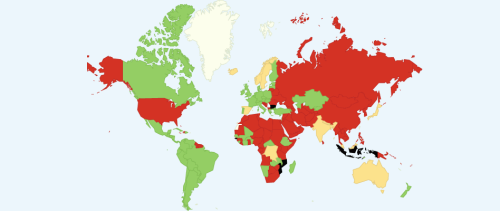
4. Causal, though athletic, sex with strangers on film, to make pornography, where filmmaker pays the woman: generally no problem
5. Donation of eggs to fertility clinic: no problem
6. Sale of eggs to fertility clinic: iffy. Amazing story here: "If you pay something, you get lots of girls."
7. Intentional abortion of 10 week old fetus: in most states, no problem.
8. Donation of baby to anonymous guardian chosen by adoption agency: no problem
9. Donation of baby to well-qualified guardian selected by mother: no problem
10. Sale of baby to well-qualified guardian selected by mother: clearly illegal, and most people would probably say a grotesque ethical violation.
Here's my question: is the difference between 10 (terrible) and 8 or 9 (admirable) really that big? And is our admiration of 8 or 9 conditioned by the idea that 7 (abortion) is really, actually, deep down ethically repulsive?
And, as always on this blog, I ask the exchange question: if donating a baby to someone you select is okay, why is selling the baby NOT okay? The problem is NOT transferring ownership of the baby. The problem is compensating a desperately poor woman who really needs the money. Are you sure that's the right policy? Why does everyone hate poor people?
NYT: Why Kidney Sales Should Be Legal
Guest op-ed by Excerpt:
On Thursday, I will donate one of my kidneys to someone I’ve never met. Most people think this sounds like an over-the-top personal sacrifice. But the procedure is safe and relatively painless. I will spend three days in the hospital and return to work within a month. I am 21, but even for someone decades older, the risk of death during surgery is about 1 in 3,000. My remaining kidney will grow to take up the slack of the one that has been removed, so I’ll be able do everything I can do now. And I’ll have given someone, on average, 10 more years of life, years free of the painful and debilitating burden of dialysis.
If kidney donation is this easy, why do the stereotypes about heroic sacrifice persist? Part of the problem is history: before modern medical advances, organ donation used to be quite painful and dangerous. But organ donation advocates also deserve some of the blame. In a misguided attempt to make the families of brain-dead patients consent to the posthumous donation of their organs, advocates treat donors like saints. But deifying donors only serves to make not donating seem normal. When I first told some friends and family that I wanted to donate a kidney, they assumed I’d gone off my rocker. They saw it as a crazy act of self-sacrifice, rather than what it is — one of the many ways a reasonably altruistic person can help others.
This is a serious problem, because there aren’t nearly enough saints in the country to tackle the growing waiting list for a kidney. More than 34,000 people joined the waiting list in 2010; fewer than 17,000 received one. Thousands of people die waiting each year.
This is a tragedy, but it doesn’t have to be this way. The people waiting for kidneys aren’t dying because of kidney failure; they’re dying because of our failure — without Congress’s misguided effort to ban organ sales, they would have been able to get the kidneys they desperately needed.
It has been illegal to compensate kidney donors in any way since 1984. The fear behind the law — that a rich tycoon could take advantage of someone desperately poor and persuade that person to sell an organ for a pittance — is understandable. But the truth is that the victims of the current ban are disproportionately African-American and poor. When wealthy white people find their way onto the kidney waiting list, they are much more likely to get off it early by finding a donor among their friends and family (or, as Steve Jobs did for a liver transplant in 2009, by traveling to a region with a shorter list). Worst of all, the ban encourages an international black market, where desperate people do end up selling their organs, without protection, fair compensation or proper medical care.
A well-regulated legal market for kidneys would not have any of these problems. It could ensure that donors were compensated fairly — most experts say somewhere in the ballpark of $50,000 would make sense. Only the government or a chosen nonprofit would be allowed to purchase the kidneys, and they would allocate them on the basis of need rather than wealth, the same way that posthumously donated organs are currently distributed. The kidneys would be paid for by whoever covers the patient, whether that is their insurance company or Medicare. Ideally, so many donors would come forward that no patient would be left on the waiting list.
On Thursday, I will donate one of my kidneys to someone I’ve never met. Most people think this sounds like an over-the-top personal sacrifice. But the procedure is safe and relatively painless. I will spend three days in the hospital and return to work within a month. I am 21, but even for someone decades older, the risk of death during surgery is about 1 in 3,000. My remaining kidney will grow to take up the slack of the one that has been removed, so I’ll be able do everything I can do now. And I’ll have given someone, on average, 10 more years of life, years free of the painful and debilitating burden of dialysis.
If kidney donation is this easy, why do the stereotypes about heroic sacrifice persist? Part of the problem is history: before modern medical advances, organ donation used to be quite painful and dangerous. But organ donation advocates also deserve some of the blame. In a misguided attempt to make the families of brain-dead patients consent to the posthumous donation of their organs, advocates treat donors like saints. But deifying donors only serves to make not donating seem normal. When I first told some friends and family that I wanted to donate a kidney, they assumed I’d gone off my rocker. They saw it as a crazy act of self-sacrifice, rather than what it is — one of the many ways a reasonably altruistic person can help others.
This is a serious problem, because there aren’t nearly enough saints in the country to tackle the growing waiting list for a kidney. More than 34,000 people joined the waiting list in 2010; fewer than 17,000 received one. Thousands of people die waiting each year.
This is a tragedy, but it doesn’t have to be this way. The people waiting for kidneys aren’t dying because of kidney failure; they’re dying because of our failure — without Congress’s misguided effort to ban organ sales, they would have been able to get the kidneys they desperately needed.
It has been illegal to compensate kidney donors in any way since 1984. The fear behind the law — that a rich tycoon could take advantage of someone desperately poor and persuade that person to sell an organ for a pittance — is understandable. But the truth is that the victims of the current ban are disproportionately African-American and poor. When wealthy white people find their way onto the kidney waiting list, they are much more likely to get off it early by finding a donor among their friends and family (or, as Steve Jobs did for a liver transplant in 2009, by traveling to a region with a shorter list). Worst of all, the ban encourages an international black market, where desperate people do end up selling their organs, without protection, fair compensation or proper medical care.
A well-regulated legal market for kidneys would not have any of these problems. It could ensure that donors were compensated fairly — most experts say somewhere in the ballpark of $50,000 would make sense. Only the government or a chosen nonprofit would be allowed to purchase the kidneys, and they would allocate them on the basis of need rather than wealth, the same way that posthumously donated organs are currently distributed. The kidneys would be paid for by whoever covers the patient, whether that is their insurance company or Medicare. Ideally, so many donors would come forward that no patient would be left on the waiting list.
Thursday, November 24, 2011
Is a Wad of $20s Coercion, Tipping, or Euvoluntary Exchange?
Ward Boss sends this link.
Question: Is it unethical to make side payments? Are tips unethical? Since the answer is NOT always "yes," when does a tip become unethical?
And the guy who "bought" a seat on 1st Class...how interesting. There, I can the problem the airline has. If I have Gold Medallion status, or take Fundman (who has "Colossus Bestride the World" status, and the issue is "can you sell your seat?" We have made it so you can scalp seats at a concert. How about on a plane? The problem is not just the security issues (which are pretty dumb, if we are both going to be on the plane anyway). The problem is that the airline is trying to segment the market so they can price discriminate. Reselling ruptures the market segmentation necessary for that to work.
So, you can GIVE me your seat in the bulkhead, or even in first class. But you can't SELL it to me.
Side payments can, under some viewpoints, make a choice voluntary. My Duke colleague Jonathan Weiner has done some good work (Wiener 1999, Global Environmental Regulation: Instrument Choice in Legal Context, Yale Law Journal, Vol. 108, January 1999, SSRN Link) on this question. He looks at "beneficiaries pay" rather than "polluters pay" problems in the environment.
Other people would say that side payments are NOT voluntary, and in fact are coercive. Because they would define anything that "makes" me do something I would not otherwise do as coercive. This perspective is discussed (though not explcitly advocated) by another Duke colleague, Ruth Grant (Strings Attached: Untangling the Ethics of Incentives, Princeton U Press, November 2011)
Question: Is it unethical to make side payments? Are tips unethical? Since the answer is NOT always "yes," when does a tip become unethical?
And the guy who "bought" a seat on 1st Class...how interesting. There, I can the problem the airline has. If I have Gold Medallion status, or take Fundman (who has "Colossus Bestride the World" status, and the issue is "can you sell your seat?" We have made it so you can scalp seats at a concert. How about on a plane? The problem is not just the security issues (which are pretty dumb, if we are both going to be on the plane anyway). The problem is that the airline is trying to segment the market so they can price discriminate. Reselling ruptures the market segmentation necessary for that to work.
So, you can GIVE me your seat in the bulkhead, or even in first class. But you can't SELL it to me.
Side payments can, under some viewpoints, make a choice voluntary. My Duke colleague Jonathan Weiner has done some good work (Wiener 1999, Global Environmental Regulation: Instrument Choice in Legal Context, Yale Law Journal, Vol. 108, January 1999, SSRN Link) on this question. He looks at "beneficiaries pay" rather than "polluters pay" problems in the environment.
Other people would say that side payments are NOT voluntary, and in fact are coercive. Because they would define anything that "makes" me do something I would not otherwise do as coercive. This perspective is discussed (though not explcitly advocated) by another Duke colleague, Ruth Grant (Strings Attached: Untangling the Ethics of Incentives, Princeton U Press, November 2011)
Friday, November 18, 2011
Tales From the Front: Exchange is Immoral!
Step 1: Duke kids are smart, and care about their living arrangements.
Step 2: Duke administrators care about a concept that they made up, though it has no actual meaning. And that concept is "fairness."
Step 3: Duke administrators keep making up new rules and than are appalled, aghast, agonized (and other words starting with letters of the alphabet) Duke students will try to game the system to compete for better room arrangements.
Step 4: Duke administrators then try to change the rules, punish those who follow the rules, etc. If "fair" has ANY meaning, it must surely be "do not constantly change the rules" and "do not punish people who follow the rules, just because you don't like the outcome."
Now, Duke is going to change the rules, to make things more fair. Really.
Some background. Some more background. For years, Duke has allowed groups or blocks to have priority in room selection. The reason is that it is easier to fit in small groups and individuals once the larger groups have been placed. This year the admins decided that it would be better to make it effectively impossible for any except large groups to have any choice whatsoever in room selection. And they wanted to limit the choice even the big groups got, so they instituted a lottery.
One of the features of a lottery, of course, is that the assignment of a group to a space allocation has zero, zilch, bagel, nada to do with how much that group VALUES that location. And since a number of the groups are more or less the same size (and since size is variable, and growth or shrinkage might change allocations in the future), some groups thought about what we economists call "side payments."
For example, suppose one group, an ad hoc group based on some shared interest or goal (the "Baseball Stats Study Group") gets assigned prime dorm space on the main quad on west campus. This is pretty noisy space for an intellectual group, but would be perfect for a group that is a frat.
And suppose a frat, Iota Tappa Kegga, about the same size, gets assigned a space way off the main quad, in a queit corner of the dorms.
Now, the BSSG likes the main quad space, because it is convenient for classes. But it is noisy, and the BSSG-ers value the space only slightly. But the ITKs really value that spot. The ITKs take up a collection, and are willing to offer a payment of $5,000 to make the change.
The result is that BSSG gets the $5,000, which they value much more than the space. The ITKs get the prime space, which they value much more than $5,000. And no one else is harmed, or even effected. (If anything, the noise externality is reduced, since moving ITK to the main quad means nobody will notice their noise over the bedlam already there, whereas if ITK had stayed in the back corner their noise would have bothered the neighbors.)
Here's the cool part. When the crack Duke admins learned of the plans to exchange, that was fine. No objection, the rules allowed for groups to trade, all it took was a majority of each group.
But THEN the staff learned of the plans to offer side payments! Outrage! The Dukites were immediately ill-tempered, impassioned, incensed, indignant, inflamed, infuriated, irascible, irate, ireful, irritable, irritated (and other words starting with letters of the alphabet). This email was sent out (I am totally NOT making this up):
Oct 28, 2011
Hello,
Unfortunately, some behaviors have been brought to our attention that are deeply disturbing. Apparently some groups, very few I am convinced, have included offers of rather large sums of funds to encourage another group to trade houses with them.
To be clear, any exchange of houses found to have involved money as part of the agreement will not be approved. If approval is granted and the exchange of funding comes to light at some point in the future, the approval will be rescinded. Other referrals deemed appropriate for this behavior will be made.
This behavior contradicts the intent and spirit of the opportunity the Duke Houses committee offered groups at this point of the process, an opportunity only considered because several student voices advocated for this chance. Eliminating the opportunity for a trade was considered, but we hate to punish all involved for the actions of a very few. This may change however if this behavior does not cease immediately.
I have head from a number of groups already and there is such excitement out there for what lies ahead in fall, 2012. Let us make that the defining theme of what is happening right now, and not these other actions.
Sincerely, XXX YYYYYYYYYY
Associate Dean for Residence Life
Co-Chair, Duke Houses
There is just so much to like here. "Behaviors"? You mean like making offers that make two parties better, and no one worse, off? "Referrals"? To the police? To Santa Claus? To the kids' priest/rabbi/vicar/imam/sociology professor (depending on their religion)? "Eliminating the opportunity for a trade was considered..." Wow! Trade is fine. Exchange is illegal. (The actual max offered, btw? $15,000!) These Jesuitical distinctions would have had ol' Thomas A himself scratching his Aristotelian head and thinking, "WTF? I mean, WTFingF?"
*****************
UPDATE: I am SO happy. This is exactly the sort of thing I had hoped this blog would encourage. Well done, lad. A good analysis, and good questions.
UPDATE 2: Another student works on the problem. This is what the blog is for, folks!
Step 2: Duke administrators care about a concept that they made up, though it has no actual meaning. And that concept is "fairness."
Step 3: Duke administrators keep making up new rules and than are appalled, aghast, agonized (and other words starting with letters of the alphabet) Duke students will try to game the system to compete for better room arrangements.
Step 4: Duke administrators then try to change the rules, punish those who follow the rules, etc. If "fair" has ANY meaning, it must surely be "do not constantly change the rules" and "do not punish people who follow the rules, just because you don't like the outcome."
Now, Duke is going to change the rules, to make things more fair. Really.
Some background. Some more background. For years, Duke has allowed groups or blocks to have priority in room selection. The reason is that it is easier to fit in small groups and individuals once the larger groups have been placed. This year the admins decided that it would be better to make it effectively impossible for any except large groups to have any choice whatsoever in room selection. And they wanted to limit the choice even the big groups got, so they instituted a lottery.
One of the features of a lottery, of course, is that the assignment of a group to a space allocation has zero, zilch, bagel, nada to do with how much that group VALUES that location. And since a number of the groups are more or less the same size (and since size is variable, and growth or shrinkage might change allocations in the future), some groups thought about what we economists call "side payments."
For example, suppose one group, an ad hoc group based on some shared interest or goal (the "Baseball Stats Study Group") gets assigned prime dorm space on the main quad on west campus. This is pretty noisy space for an intellectual group, but would be perfect for a group that is a frat.
And suppose a frat, Iota Tappa Kegga, about the same size, gets assigned a space way off the main quad, in a queit corner of the dorms.
Now, the BSSG likes the main quad space, because it is convenient for classes. But it is noisy, and the BSSG-ers value the space only slightly. But the ITKs really value that spot. The ITKs take up a collection, and are willing to offer a payment of $5,000 to make the change.
The result is that BSSG gets the $5,000, which they value much more than the space. The ITKs get the prime space, which they value much more than $5,000. And no one else is harmed, or even effected. (If anything, the noise externality is reduced, since moving ITK to the main quad means nobody will notice their noise over the bedlam already there, whereas if ITK had stayed in the back corner their noise would have bothered the neighbors.)
Here's the cool part. When the crack Duke admins learned of the plans to exchange, that was fine. No objection, the rules allowed for groups to trade, all it took was a majority of each group.
But THEN the staff learned of the plans to offer side payments! Outrage! The Dukites were immediately ill-tempered, impassioned, incensed, indignant, inflamed, infuriated, irascible, irate, ireful, irritable, irritated (and other words starting with letters of the alphabet). This email was sent out (I am totally NOT making this up):
Oct 28, 2011
Hello,
Unfortunately, some behaviors have been brought to our attention that are deeply disturbing. Apparently some groups, very few I am convinced, have included offers of rather large sums of funds to encourage another group to trade houses with them.
To be clear, any exchange of houses found to have involved money as part of the agreement will not be approved. If approval is granted and the exchange of funding comes to light at some point in the future, the approval will be rescinded. Other referrals deemed appropriate for this behavior will be made.
This behavior contradicts the intent and spirit of the opportunity the Duke Houses committee offered groups at this point of the process, an opportunity only considered because several student voices advocated for this chance. Eliminating the opportunity for a trade was considered, but we hate to punish all involved for the actions of a very few. This may change however if this behavior does not cease immediately.
I have head from a number of groups already and there is such excitement out there for what lies ahead in fall, 2012. Let us make that the defining theme of what is happening right now, and not these other actions.
Sincerely, XXX YYYYYYYYYY
Associate Dean for Residence Life
Co-Chair, Duke Houses
There is just so much to like here. "Behaviors"? You mean like making offers that make two parties better, and no one worse, off? "Referrals"? To the police? To Santa Claus? To the kids' priest/rabbi/vicar/imam/sociology professor (depending on their religion)? "Eliminating the opportunity for a trade was considered..." Wow! Trade is fine. Exchange is illegal. (The actual max offered, btw? $15,000!) These Jesuitical distinctions would have had ol' Thomas A himself scratching his Aristotelian head and thinking, "WTF? I mean, WTFingF?"
*****************
UPDATE: I am SO happy. This is exactly the sort of thing I had hoped this blog would encourage. Well done, lad. A good analysis, and good questions.
UPDATE 2: Another student works on the problem. This is what the blog is for, folks!
Subscribe to:
Posts (Atom)