Billion-dollar-a-year company A runs hellish factories in some of the most poverty-stricken places on earth. Their money-grubbing executives ruthlessly shave labor costs to just barely above workers' BATNA of subsistence farming.
Billion-dollar-a-year company B is fully domestic. They pay above-market wages, have generous 401(k) matches, and pick up most of the premium on their low-deductible health plans. They contribute to the local children's hospital and the employees can often be found building playgrounds in their off-time.
Billion-dollar-a-year company C is international, but unlike company A, they have sanitary, safe, modern factories in developing countries thanks to generous grants from large charitable foundations. They have worker training programs and offer full academic scholarships to the children of employees.
Neither A nor B nor C violate any local laws or labor practices. In the popular press, A is routinely excoriated for sweatshop abuses, while B is held as an example of ethics in business. Think WalMart vs Costco if you like. C, however, is supererogatory. They could be more like A, they might even be profit-maximizing by being more like A, but they choose not to. Perhaps it's out of a sense of duty, perhaps it's to signal to social-minded customers at home, but whatever the reason, they exceed their fiduciary responsibilities (maybe: it's an empirical question whether or not stock price suffers for the decision).
Economists are quick to point out that company A does more to directly improve the lot of workers with dismal alternatives (company B adds to worldwide productivity, which reduces the relative prices of all goods, but it's a fly eructation in a hurricane in a general equilibrium plagued with real-world frictions). In this sense, the hidden assumption is that the natural alternative to A is B. Anti-sweatshop protesters and workers' rights organizations assume that the alternative to A is C. At least I hope that's what they assume. Which assumption better matches reality?
Well, that's an empirical question. Intuitively, the sort of rattletrap operation in A should rely on shallower capital requirements: build a shabby factory, have it crank out t-shirts just long enough to cover costs and don't worry too much about what happens next. This, intuitively anyway, should be more likely in places with particularly nasty political, social, or industrial risk. Domestic production in B is a business decision like any other. Maybe overseas factories are impractical for whatever reason, maybe not. Keeping production at home is still erogatory. There is no common law duty for firms to hire desperate foreign workers or to indulge in the fantasies of international development. The experts can't even get that stuff right. To get C, again—intuitively, you need some combination of low labor costs and stability. For folks in those types of countries, it's a pretty sweet gig, so long as you can get it. Of course, it's a pretty sweet gig even if you can't get it. Higher productivity means lower relative prices, and even if it's just a matter of public infrastructure improvements, everyone benefits from having a more productive economy.
I return to G.K. Chesterton's admonition about knocking over fences. Before you demand changes to company A's policy of running a fly-by-night operation in a developing nation, it might be wise to carefully consider their business logic and what might happen afterwards. It may very well be related to risks beyond the control of the firm. If the alternative to A is B rather than C, clamoring to shut down sweatshops could further damage the plight of the poor in the target economy. Maybe it's better to suffer A types long enough for C types to become feasible.
Then again, it's not always clear how effective name-and-shame campaigns are over the long run anyway, particularly for firms without much of a public face. Most business volume is B2B. How many raw semiconductor manufacturing concerns can you name off the top of your head? If you can't clearly pin an end product to a naughty firm, how can you effectively boycott?
Showing posts with label international trade. Show all posts
Showing posts with label international trade. Show all posts
Wednesday, April 29, 2015

Friday, January 10, 2014
Noah's Battle in Seattle
On le Twitter, NS invited the KPC crew (inter alia) to comment on this Atlantic piece. Mungo... well Mungo demurred:
Noah: Competition with foreign labor drives down domestic wages. The empirical literature [the Autor, Dorn, and Hanson link is busted, Noah] shows (SLW note: I will refrain from complaining about the IV approach ADH use) wage and employment shocks to domestic households even outside what you'd expect (manufacturing), having distributional consequences even if overall welfare is improved. Recall that K-H efficiency just says we're better off in the aggregate; this criterion still allows for some folks to lose.
Spivonomist: The point of liberalized trade is to increase capital mobility. The part of my analytical toolkit grounded in sterile economics is puzzled by a corresponding failure to increase the mobility of labor. Clemens might be overly optimistic about doubling world GDP with open borders, but I can imagine quite plausible production functions that exceed his estimates. All you need to get there are returns to thicker networks, increased specialization, and complementary firm structure. Richer organizational structure types means more experimentation with production methods, more creative destruction, and more TFP development. But all the pie-in-the-sky economic optimism I can muster inevitably gets clotheslined by political constraints as I go a-galloping through the hundred-acre wood on Eeyore's back. The AFL-CIO was the big presence at the Battle in Seattle (which I remember fondly since I was just across the Puget Sound as it happened), but with open borders on the agenda at the same time, even a lame duck Clinton fresh out of the Lewinsky wringer couldn't have made substantial immigration reform happen. No way, nohow. Marginally more mobile capital without an increase in the mobility of labor will quite naturally have distributional effects. Obviously.
Noah: Returns to increased globalization have gone to owners of capital rather than to labor.
Spivonomist: Part of that is the increased volume of pairwise euvoluntary exchange. Part of it is the result of political rents. I think you and I both agree that political rents are a problem. I don't know for sure if we agree about wealth inequalities that naturally arise as a result of more vigorous EE, but that latter question is probably relatively low priority.
Noah: Are you drinking carrot-beet juice? That's disgusting.
Spivonomist: It was good till I got to the dregs. Beet pulp is objectionable.
Noah: Product quality is a sincere collective action problem. Consumer protection is a farce in developing economies, and you know as well as I the supply chain failures characteristic of Communist regimes. There's no incentive for producers to behave scrupulously, especially with American merchants who can't be bothered to learn how Chinese business works. Also, Sam, haven't you and Alex been working on the lead-crime connection? You should know better than anyone the perils of heavy metals in toys.
Spivonomist: Yeah, with the lead and crime, the thing is, the connection isn't actually particularly robust. Including Canadian observations was the stake through that vampire's heart for me. But yes, there's an information asymmetry problem with imports. It seems to me that there are probably some pretty good, low-cost solutions to the problem. US distributors have no vested interest in poisoning their customers, so something akin to UL but for imported consumer goods seems like a pretty good idea. Put distributors on the liability hook for the mountains of plastic crap they haul across the Pacific. Tort law needs some work, but that's a problem with the tort system, not with international trade.
Noah: Pollution, bro. Global warming.
Spivonomist: Yeah, the air quality in coastal China is terrifying. But clean air is a normal good. I am reasonably confident that economics will win. As far as climate effects, carbon sequestering is a great way to transfer wealth! Why not tax wealthy Americans and Europeans to build fancy-pants algae ponds or forests and let developing countries continue using low-cost energy until the margins equalize on their own? We'll get better worldwide GINI coefficients and a healthy, happy environment. What's not to love? Unless of course environmentalism isn't about the environment. But that can't be right. Right?
Noah: I'm actually with you guys on the working conditions stuff. Rattletrap factories are places you and I wouldn't want to work, but none us of here in American Academia come from a dirt farmer background, so we shouldn't be using our own experiences to judge the BATNA of others.
Spivonomist: Oh, that's what Angus meant. Okay then.
Noah: And in the end, an end to the misery of chronic poverty for hundreds of millions of Chinese citizens is a damn fine result, so maybe their welfare should be a more important component of our moral estimations of the effects of international trade.
Spivonomist: Noah Smith is starting to sound a bit like Adam Smith there at the end. I like it.
Increasingly vigorous international trade is a step in the euvoluntary direction. There are still big problems with its specific execution, but the meet and proper response to those problems are to address them on their own terms, and emphatically not to return folks already on the brink of desperation back to their misery. Euvoluntary for me but not for thee? I'm with Noah: I can think of few sentiments as vile.
@Noahpinion @ez_angus @ModeledBehavior Heard squirrel fussin bout somethin outside. Stopped to see, but then thought, "wait-It's a squirrel"
— mungowitz (@mungowitz) January 7, 2014
Angus seemed a bit more willing, but only after being buttered up a little:
@Noahpinion LOLZ. sorry. Will get on the rebuttal. But you make it hard 'cause you take everything back at the end.
— kevin grier (@ez_angus) January 8, 2014
I'll bite though. You know, so I can say idiftl and all that. Let's hit the high points and see what we can bounce off against the rubber-lined walls of EE with our fashionably long-sleeved suit jackets.Noah: Competition with foreign labor drives down domestic wages. The empirical literature [the Autor, Dorn, and Hanson link is busted, Noah] shows (SLW note: I will refrain from complaining about the IV approach ADH use) wage and employment shocks to domestic households even outside what you'd expect (manufacturing), having distributional consequences even if overall welfare is improved. Recall that K-H efficiency just says we're better off in the aggregate; this criterion still allows for some folks to lose.
Spivonomist: The point of liberalized trade is to increase capital mobility. The part of my analytical toolkit grounded in sterile economics is puzzled by a corresponding failure to increase the mobility of labor. Clemens might be overly optimistic about doubling world GDP with open borders, but I can imagine quite plausible production functions that exceed his estimates. All you need to get there are returns to thicker networks, increased specialization, and complementary firm structure. Richer organizational structure types means more experimentation with production methods, more creative destruction, and more TFP development. But all the pie-in-the-sky economic optimism I can muster inevitably gets clotheslined by political constraints as I go a-galloping through the hundred-acre wood on Eeyore's back. The AFL-CIO was the big presence at the Battle in Seattle (which I remember fondly since I was just across the Puget Sound as it happened), but with open borders on the agenda at the same time, even a lame duck Clinton fresh out of the Lewinsky wringer couldn't have made substantial immigration reform happen. No way, nohow. Marginally more mobile capital without an increase in the mobility of labor will quite naturally have distributional effects. Obviously.
Noah: Returns to increased globalization have gone to owners of capital rather than to labor.
Spivonomist: Part of that is the increased volume of pairwise euvoluntary exchange. Part of it is the result of political rents. I think you and I both agree that political rents are a problem. I don't know for sure if we agree about wealth inequalities that naturally arise as a result of more vigorous EE, but that latter question is probably relatively low priority.
Noah: Are you drinking carrot-beet juice? That's disgusting.
Spivonomist: It was good till I got to the dregs. Beet pulp is objectionable.
Noah: Product quality is a sincere collective action problem. Consumer protection is a farce in developing economies, and you know as well as I the supply chain failures characteristic of Communist regimes. There's no incentive for producers to behave scrupulously, especially with American merchants who can't be bothered to learn how Chinese business works. Also, Sam, haven't you and Alex been working on the lead-crime connection? You should know better than anyone the perils of heavy metals in toys.
Spivonomist: Yeah, with the lead and crime, the thing is, the connection isn't actually particularly robust. Including Canadian observations was the stake through that vampire's heart for me. But yes, there's an information asymmetry problem with imports. It seems to me that there are probably some pretty good, low-cost solutions to the problem. US distributors have no vested interest in poisoning their customers, so something akin to UL but for imported consumer goods seems like a pretty good idea. Put distributors on the liability hook for the mountains of plastic crap they haul across the Pacific. Tort law needs some work, but that's a problem with the tort system, not with international trade.
Noah: Pollution, bro. Global warming.
Spivonomist: Yeah, the air quality in coastal China is terrifying. But clean air is a normal good. I am reasonably confident that economics will win. As far as climate effects, carbon sequestering is a great way to transfer wealth! Why not tax wealthy Americans and Europeans to build fancy-pants algae ponds or forests and let developing countries continue using low-cost energy until the margins equalize on their own? We'll get better worldwide GINI coefficients and a healthy, happy environment. What's not to love? Unless of course environmentalism isn't about the environment. But that can't be right. Right?
Noah: I'm actually with you guys on the working conditions stuff. Rattletrap factories are places you and I wouldn't want to work, but none us of here in American Academia come from a dirt farmer background, so we shouldn't be using our own experiences to judge the BATNA of others.
Spivonomist: Oh, that's what Angus meant. Okay then.
Noah: And in the end, an end to the misery of chronic poverty for hundreds of millions of Chinese citizens is a damn fine result, so maybe their welfare should be a more important component of our moral estimations of the effects of international trade.
Spivonomist: Noah Smith is starting to sound a bit like Adam Smith there at the end. I like it.
Increasingly vigorous international trade is a step in the euvoluntary direction. There are still big problems with its specific execution, but the meet and proper response to those problems are to address them on their own terms, and emphatically not to return folks already on the brink of desperation back to their misery. Euvoluntary for me but not for thee? I'm with Noah: I can think of few sentiments as vile.
Tuesday, August 13, 2013
Global Markets: Voluntary?
At first I thought this was just typical economically illiterate reporting:
The U.S. is now swimming in oil, thanks to the oil shale revolution that has turned places like North Dakota into the new Saudi Arabia. The U.S. still has a law on the books – passed during the oil shock of 1979 – that prohibits the export of crude oil, except to Canada and Mexico. The law, however, makes no mention of oil that has been refined into gasoline or diesel fuel. It's diesel fuel that is leading the petroleum export surge.
The profit margins are higher and the international demand is stronger for diesel than gasoline. Much of the world's automobile fleet runs on diesel. But a number of consumer advocates have wondered aloud in recent months whether this rush to sell refined petroleum products to the rest of the world hasn't hurt the U.S. consumer. If we have so much excess petroleum product, why aren't U.S. pump prices lower?
To be fair, the author (Mark Hoffman) says, "wait, it's not that simple."
But there is actually a broader issue. If the world price is above the domestic autarky price, it's always true that an open economy "hurts" domestic consumers, at least on that one commodity. So, my question is this: is participating in an open economy a voluntary act, by consumers? What about producers, when the world price is below the domestic autarky price? How are the property rights to access to global markets, or to foreclose access to global markets, distributed?
Don't say "politics," because that's true in every UNimportant respect. If you think property rights are important, who owns this right? If you think the answer is that no one can prevent someone else from engaging in a transaction, then how is that right to be enforced?
The U.S. is now swimming in oil, thanks to the oil shale revolution that has turned places like North Dakota into the new Saudi Arabia. The U.S. still has a law on the books – passed during the oil shock of 1979 – that prohibits the export of crude oil, except to Canada and Mexico. The law, however, makes no mention of oil that has been refined into gasoline or diesel fuel. It's diesel fuel that is leading the petroleum export surge.
The profit margins are higher and the international demand is stronger for diesel than gasoline. Much of the world's automobile fleet runs on diesel. But a number of consumer advocates have wondered aloud in recent months whether this rush to sell refined petroleum products to the rest of the world hasn't hurt the U.S. consumer. If we have so much excess petroleum product, why aren't U.S. pump prices lower?
To be fair, the author (Mark Hoffman) says, "wait, it's not that simple."
But there is actually a broader issue. If the world price is above the domestic autarky price, it's always true that an open economy "hurts" domestic consumers, at least on that one commodity. So, my question is this: is participating in an open economy a voluntary act, by consumers? What about producers, when the world price is below the domestic autarky price? How are the property rights to access to global markets, or to foreclose access to global markets, distributed?
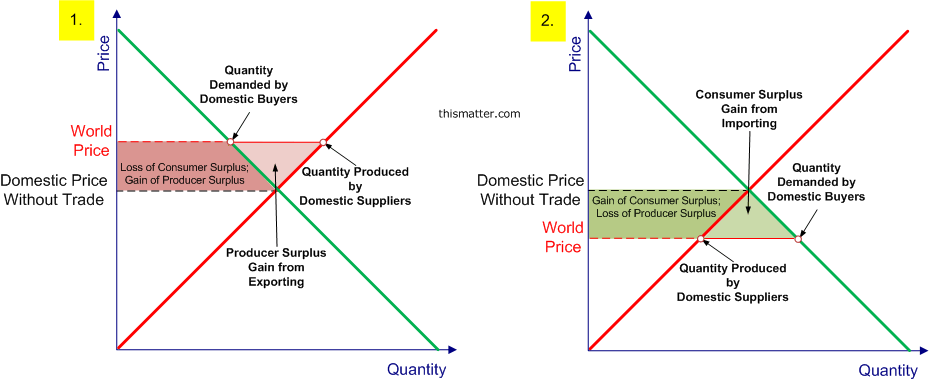
Don't say "politics," because that's true in every UNimportant respect. If you think property rights are important, who owns this right? If you think the answer is that no one can prevent someone else from engaging in a transaction, then how is that right to be enforced?
Tuesday, March 13, 2012
Trade War and the Euvoluntary Principle
Fighting a trade war is like going to a gunfight with an open breech. The state inevitably (and by "inevitably", I mean as a simple identity) harms its constituents as much it harms as the supposed opponent. Recall that by revealed preference, voluntary trade makes both parties to trade better off. Recall also that hostility is often met with hostility. When an administration bars Chinese tires from being shipped to the US, perhaps they ought not be too taken aback when China allegedly hoards rare earth minerals a few years later.
Now, this may not be Smoot-Hawley all over again, but it can be a reminder that unintended consequences are by no means unforeseeable consequences. In a rush to protect American consumers (?) from the devastating effects of inexpensive foreign tires, firms now find natural magnets more dear. Funny how that works.
Politicians and journalists like to talk about leveling the playing field. Pity that their bulldozer often ends up salting the earth.
Apologies for the godawful analogy.
I think the euvoluntary connection here is that moral intuitions about the value of trade just fly out the window when dealing with outsiders. If the median voter is distrustful of foreigners and elected officials seek an edge in the polls, then trade partners can make for an effectively voiceless scapegoat. Even when foreign trade is actually euvoluntary, it can be easy enough to make a man-of-straw case that it isn't.
Now, this may not be Smoot-Hawley all over again, but it can be a reminder that unintended consequences are by no means unforeseeable consequences. In a rush to protect American consumers (?) from the devastating effects of inexpensive foreign tires, firms now find natural magnets more dear. Funny how that works.
Politicians and journalists like to talk about leveling the playing field. Pity that their bulldozer often ends up salting the earth.
Apologies for the godawful analogy.
I think the euvoluntary connection here is that moral intuitions about the value of trade just fly out the window when dealing with outsiders. If the median voter is distrustful of foreigners and elected officials seek an edge in the polls, then trade partners can make for an effectively voiceless scapegoat. Even when foreign trade is actually euvoluntary, it can be easy enough to make a man-of-straw case that it isn't.
Tuesday, February 28, 2012
My Fair Lady
"Unfairness" can be a powerful word upon the lips of the powerful. A new Interagency Trade Enforcement Center is set to correct for the injustices of "unfair trade practices"--a phrase I confess to not fully comprehending.
Is there something non-euvoluntary about trade with foreign businesses? If the issue is on uncompensated externalities, why does China form a special class? Why not also assign this new agency the power to prosecute technological improvements as well? After all, improvements to production processes shift patterns of production and trade as surely as exchanging goods manufactured abroad.
I'm also sort of interested in the statutory authority of this agency. Unless I'm badly mistaken, tariffs and import duties and the like are controlled by Congress. The AP report is light on specifics. As soon as I get a look at the agency's charter, I will post follow-up commentary.
Thursday, January 26, 2012
Show Me the Daylight 'twixt Sanction and Tariff
Sorry about the double post, people. It's just that something's been bothering me the last couple of days.
See, the United States government has been tightening economic sanctions against Iran for typical saber-rattling reasons: they pose a threat to global peace, they have a nuclear program, et al. (I will dutifully refrain from snark here), but what do "economic sanctions" entail? Blocking foreign trade. A trade embargo forces the embargoed nation into autarky. As economic theory predicts, this makes the citizens of the affected nation poorer.
Yet at other times, perhaps when accusing Chinese monetary authorities of currency manipulation (and no, I don't have an economics-based definition of currency manipulation standing by), the political response is to impose similar sanctions on the home country.
I think I have a blind spot here. When country X imposes an embargo on country Y, this is regarded as an act of war. When country X imposes an embargo on itself, this is ennobling trade protection. In both circumstances, the citizens of the affected country are unable to freely conduct trade for mutual advantage.
If I had to hazard a guess, and I'm not sure I really want to, I think that the trade protection racket grazes the boundaries of euvoluntary exchange. If we set aside anti-foreign bias for the moment, we might imagine that the claim is somehow about externalities: trade with foreign businesses imposes costs upon domestic businesses who have to reduce prices (and wages) to compete. This occurs through no fault of the domestic business, therefore the political process must mitigate or eliminate the untoward competition. Furthermore, it's critical that this be done from the home country; if someone does it for us, that's cause to declare war (viz. United States and Japan ca. 1939) or worse.
Neil Gaiman is one of my favorite authors and I seem to retain many of the bon mots he sprinkled liberally through The Sandman comics. One that seems apropos in this case goes something like this: "a chicken with its head cut off is different than a chicken with its neck wrung, but it doesn't matter to the chicken." If government exists to serve the interests of the people, well, they sure have a funny way of showing it.
See, the United States government has been tightening economic sanctions against Iran for typical saber-rattling reasons: they pose a threat to global peace, they have a nuclear program, et al. (I will dutifully refrain from snark here), but what do "economic sanctions" entail? Blocking foreign trade. A trade embargo forces the embargoed nation into autarky. As economic theory predicts, this makes the citizens of the affected nation poorer.
Yet at other times, perhaps when accusing Chinese monetary authorities of currency manipulation (and no, I don't have an economics-based definition of currency manipulation standing by), the political response is to impose similar sanctions on the home country.
I think I have a blind spot here. When country X imposes an embargo on country Y, this is regarded as an act of war. When country X imposes an embargo on itself, this is ennobling trade protection. In both circumstances, the citizens of the affected country are unable to freely conduct trade for mutual advantage.
If I had to hazard a guess, and I'm not sure I really want to, I think that the trade protection racket grazes the boundaries of euvoluntary exchange. If we set aside anti-foreign bias for the moment, we might imagine that the claim is somehow about externalities: trade with foreign businesses imposes costs upon domestic businesses who have to reduce prices (and wages) to compete. This occurs through no fault of the domestic business, therefore the political process must mitigate or eliminate the untoward competition. Furthermore, it's critical that this be done from the home country; if someone does it for us, that's cause to declare war (viz. United States and Japan ca. 1939) or worse.
Neil Gaiman is one of my favorite authors and I seem to retain many of the bon mots he sprinkled liberally through The Sandman comics. One that seems apropos in this case goes something like this: "a chicken with its head cut off is different than a chicken with its neck wrung, but it doesn't matter to the chicken." If government exists to serve the interests of the people, well, they sure have a funny way of showing it.
Tuesday, December 20, 2011
Where's the Harm?
Swedish butter thugs ship in contraband butter.
Heroic Norwegian police spend hundreds of thousands of dollars on patrols to insure that no butter is brought into Norway. Oh, and the cops are going to destroy the butter, presumably by rubbing it on themselves, and each other, in the sauna. ("WHEEEEE!")
The problem: Norway has a butter shortage. Not because of a hurricane, or a natural disaster, but because... the Norwegian police have laid siege to the country.
A video from Norway, "explaining." Wow. Not sure how could someone could be this confused. (Yes, probably a goof. But gotta give credit. A brilliant goof.)
If a foreign army had surrounded Norway (okay, you'd need a navy, too, but pay attention!), and prevented products from being shipped in, that would be an act of war, right?
But if Norway does it TO ITSELF, it's called "protection."
My question: given that the EU price of butter is , what in the world are the Norwegians doing? Let's put it this way: would you rather be a poor Swede munching down delicious butter cookies, or a rich Norge who can't afford butter? The point of an economy is to get STUFF, not MONEY. Midas died of starvation. Merry Christmas, Norway, enjoy all the money you can't spend on the stuff you need.
Heroic Norwegian police spend hundreds of thousands of dollars on patrols to insure that no butter is brought into Norway. Oh, and the cops are going to destroy the butter, presumably by rubbing it on themselves, and each other, in the sauna. ("WHEEEEE!")
The problem: Norway has a butter shortage. Not because of a hurricane, or a natural disaster, but because... the Norwegian police have laid siege to the country.
A video from Norway, "explaining." Wow. Not sure how could someone could be this confused. (Yes, probably a goof. But gotta give credit. A brilliant goof.)
If a foreign army had surrounded Norway (okay, you'd need a navy, too, but pay attention!), and prevented products from being shipped in, that would be an act of war, right?
But if Norway does it TO ITSELF, it's called "protection."
My question: given that the EU price of butter is , what in the world are the Norwegians doing? Let's put it this way: would you rather be a poor Swede munching down delicious butter cookies, or a rich Norge who can't afford butter? The point of an economy is to get STUFF, not MONEY. Midas died of starvation. Merry Christmas, Norway, enjoy all the money you can't spend on the stuff you need.
Friday, October 21, 2011
Is It Ethical to Give It Away?
This seems nice, heartwarming, helpful, etc. 
But when Chinese manufacturers sell socks, clothing, toys, and other things that poor people in the U.S. really need for ALMOST nothing, we get angry at them. Exploiters! What is up with that?
(Nod to Ihatepeacocks for the photo, and to slammin' Sam Wilson for noticing the connection.

But when Chinese manufacturers sell socks, clothing, toys, and other things that poor people in the U.S. really need for ALMOST nothing, we get angry at them. Exploiters! What is up with that?
(Nod to Ihatepeacocks for the photo, and to slammin' Sam Wilson for noticing the connection.
Subscribe to:
Posts (Atom)